The Fields medals are considered the ultimate accolade in mathematics. First awarded in 1936, since 1950 up to four of them have been awarded every four years at the International Congress of Mathematicians, with the latest round due this August in Rio de
The roll call of previous winners, who have to be under the age of 40, includes some of the subject’s most intriguing characters – often unheard of in the wider world.
Maryam Mirzakhani
Maryam Mirzakhani/Corbis via Getty Images
Advertiseme
2014 – Maryam Mirzakhani (1977-2017)
The first – and thus far only – woman to win the Fields Medal, the Iranian Maryam Mirzakhani was honoured for her studies of the geometry of moduli space, a complex geometric and algebraic entity that might be described as a universe in which every point is itself a universe. Already diagnosed with breast cancer at the time of the award, Mirzakhani died last year, aged just 40.
Cédric Villani
GARY DOAK / Alamy Stock Photo
2010 – Cédric Villani (1973- )
Villani became something of a celebrity following his 2010 Fields medal win. Once dubbed the Lady Gaga of French mathematicians, that epithet has less to do with his prize-winning work, on the mathematical interpretation of the concept of entropy, than with his distinctive dress sense, often combining ornate velvet cravats with metallic spider brooches.
More approachable than some former winners, and the author of a popular book on mathematics, Villani added another string to his bow in June 2017 when he was elected to the French national assembly as a representative of La République En Marche!, the party founded by now-president Emmanuel Macron.
Perelman, a reclusive Russian, finally proved it true in 2002. The significance of his achievement was somewhat overshadowed, however, by his subsequent refusal of the prize – and the Fields medal that followed.
Andrew Wiles
AZ Goriely
1998 – Andrew Wiles (1953- ) [silver plaque]
Wiles was too old to receive a Fields medal when his landmark proof of Fermat’s Last Theorem reached its final form in 1994. At the next round in 1998, he was granted a unique award in recognition of his achievement: a silver plaque.
The theorem states that no three integers a, b, c exist that can satisfy the equation an + bn = cn where n is greater than 2. (Solutions for n = 2 are easy: 3, 4 and 5, for example, the numbers that make up the sides of a classic “Pythagorean” right-angled triangle.) It had bugged mathematicians ever since 1637, when the French mathematician Pierre de Fermat claimed in a note scribbled in a book margin to have a proof just too long to fit there. If so, we’re missing something: Wiles’s version spanned several hundred pages of cutting-edge 20th century mathematics.
Ed Witten
Tim Mosenfelder/Getty
1990 – Edward Witten (1951- )
In the words of Michael Atiyah, himself a 1966 Fields medallist, Witten’s “command of mathematics is rivalled by few mathematicians”. Witten is actually a physicist, and his prize was for a mathematical proof of a theorem stemming from Einstein’s general theory of relativity. He is perhaps best known for his subsequent work unifying different flavours of string theory, an attempt to move beyond general relativity to a “theory of everything” that unifies all of nature’s forces. In a less formal award, a poll of physicists attending a cosmology conference the same year saw him dubbed “the world’s smartest physicist”.
Alain Connes
Sipa Press/REX/Shutterstock
1982 – Alain Connes (1947- )
Connes built on work by the polymath John von Neumann, a man often described as the last mathematician who understood all of the subject, on algebras relevant to the weird world of quantum theory. He has since worked on establishing “non-commutative” geometries that might provide new mathematical insights into the standard model of particle physics, and perhaps a more unified view of mathematics. In recent years, he has also collaborated with the physicist Carlo Rovelli in an attempt to establish a mathematically grounded description of one of the biggest mysteries in physics: why we experience a flowing time.
Alexander Grothendieck
REX/Shutterstock
1966 – Alexander Grothendieck (1928-2014)
Grothendieck’s work in the field of algebraic geometry laid the foundation for much of modern mathematics, including Andrew Wiles’s famed 1994 proof of Fermat’s Last Theorem. It is famously abstract: an obituary written for the scientific journal Nature was nearly rejected when it turned out that almost none of his work could be sufficiently simplified. Some-time New Scientist contributor Richard Elwes sang in a musical tribute in 2016 that it makes less high-powered mathematicians’ “palms go sweaty and knees go weak”.
Grothendieck was an intense man of profound personal conviction. In 1966, he refused to travel to Moscow to collect his Fields medal in protest at the actions of the Soviet regime, and the following year, in response to US involvement in the Vietnam war, went to Hanoi to give mathematics lectures while the bombs fell around him. After retiring from the University of Montpelier in 1988, he retreated to a small village at the foot of the Pyrenees, where he lived in isolation until his death
Friday, January 24, 2020
The top 10 mathematical achievements of the last 5ish years
10. Mochizuki’s claimed proof of the abc conjecture. The countdown kicks off on an awkward note. If Shinichi Mochizuki’s 2012 claimed proof of the abc conjecture had gained widespread acceptance, it would definitely top this list. As it is, it remains in limbo, to the enormous frustration of everyone involved.
9. The weak Goldbach conjecture. “From 7 onwards, every odd number is the sum of three primes.” We have known since 1937 that this holds for all large enough odd numbers, but in 2013 Harald Helfgott brought the threshold down to 1030, and separately with David Platt checked odd numbers up to that limit by computer.
8. Ngô Bảo Châu’s proof of the Fundamental Lemma. Bending the rules to scrape in (time-wise) is this 2009 proof of a terrifyingly technical but highly important plank of the Langlands Program.
7. Seventeen Sudoku Clues. In 2012, McGuire, Tugemann, and Civario proved that the smallest number of clues which uniquely determine a Sudoku puzzle is 17. (Although not every collection of 17 clues yields a unique solution, their theorem establishes that there can never be a valid Sudoku puzzle with only 16 clues.)
6. The Growth of Univalent Foundations/ Homotopy Type Theory. This new approach to the foundations of mathematics, led by Vladimir Voevodsky, is attracting huge attention. Apart from its inherent mathematical appeal, it promises to recast swathes of higher mathematics in a language more accessible to computerised proof-assistants.
5. Untriangulatable spaces. In sixth position is the stunning discovery, by Ciprian Manolescu, ofuntriangilatable manifolds in all dimensions from 5 upwards.
4. The Socolar–Taylor tile. Penrose tiles, famously, are sets of tiles which can tile the plane, but only aperiodically. It was an open question, for many years, whether it is possible to achieve the same effect with just one tile. Then Joan Taylor and Joshua Socolar found one (pictured above).
3. Completion of the Flyspeck project. In 1998, Thomas Hales announced a proof of the classicKepler conjecture on the most efficient way to stack cannon-balls. Unfortunately, his proof was so long and computationally involved that the referees assigned to verify it couldn’t complete the task. So Hales and his team set about it themselves, using the Isabelle and HOL Light computational proof assistants. The result is not only a milestone in discrete geometry, but also in automated reasoning.
2. Partition numbers. In how many ways can a positive integer be written as a sum of smaller integers? In 2011, Ken Ono and Jan Bruinier provided the long-sought answer.
1. Bounded gaps between primes. It’s no real surprise to find that the top spot is taken by Yitang Zhang’s wonderful 2013 result that there is some number n, below 70 million, such that there are infinitely many pairs of consecutive primes exactly n apart. The subsequent flurry of activity saw James Maynard, and a Polymath Project organised by Terence Tao, bring the bound down to 246.
Friday, January 10, 2020
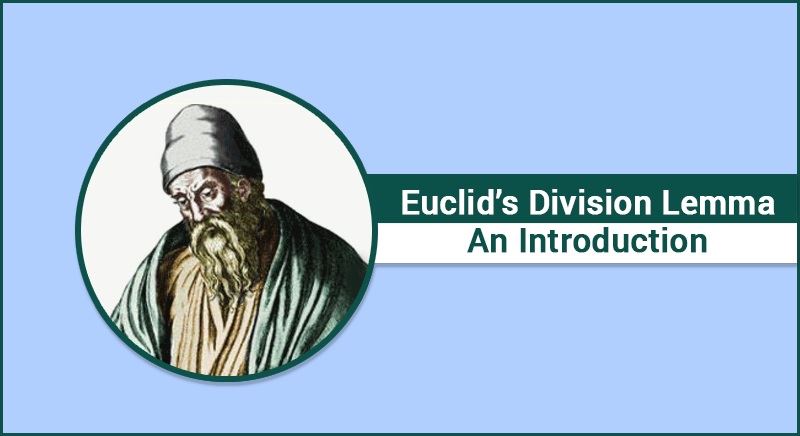
Euclid's Division Lemma:
According to Euclid’s Division Lemma if we have two positive integers a and b, then there exist unique integers q and r which satisfies the condition a = bq + r where 0 ≤ r ≤ b.
The basis of the Euclidean division algorithm is Euclid’s division lemma. To calculate the Highest Common Factor (HCF) of two positive integers a and b we use Euclid’s division algorithm. HCF is the largest number which exactly divides two or more positive integers. By exactly we mean that on dividing both the integers a and b the remainder is zero.
Let us now get into the working of this euclidian algorithm.
Euclid’s Division Lemma Algorithm
Consider we have two numbers 78 and 980 and we need to find the HCF of both of these numbers. To do this, we choose the largest integer first, i.e. 980 and then according to Euclid Division Lemma, a = bq + r where 0 ≤ r ≤ b;
980 = 78 × 12 + 44
Now, here a = 980, b = 78, q = 12 and r = 44.
Now consider the divisor as 78 and the remainder 44 and apply the Euclid division method again, we get
78 = 44 × 1 + 34
Similarly, consider the divisor as 44 and the remainder 34 and apply the Euclid division method again, we get
44 = 34 × 1 + 10
Following the same procedure again,
34 = 10 × 3 + 4
10=4×2+2
4=2×2+0
As we see that the remainder has become zero, therefore, proceeding further is not possible and hence the HCF is the divisor b left in the last step which in this case is 2. We can say that the HCF of 980 and 78 is 2.
Let us try another example to find the HCF of two numbers 250 and 75. As the larger integer is 250, therefore, applying Euclid Division Lemma a = bq + r where 0 ≤ r ≤ b, we have
a = 250 and b = 75
⇒ 250 = 75 × 3 + 25
Applying the Euclid’s Division Algorithm again we have,
75 = 25 × 3 + 0
As the remainder becomes zero, we cannot proceed further. According to the algorithm, divisor in this case which is 25 here is the HCF of 250 and 75.
Example
Example: Find the HCF of 81 and 675 using the Euclidean division algorithm.
Solution: The larger integer is 675, therefore, applying the Division Lemma a = bq + r where 0 ≤ r ≤ b, we have
a = 675 and b = 81
⇒ 675 = 81 × 8 + 27
Applying the Euclid’s Division Algorithm again we have,
81 = 27 × 3 + 0
We cannot proceed further as the remainder becomes zero. According to the algorithm divisor, in this case, is 27 which is the HCF of 675 and 81.