Sunday, December 29, 2019

Sudoku Answers


Math Riddles

Logic Games And Riddles


Riddle 1
How can you add eight 8's to get the number 1,000? (only use addition)
number 8 math riddle
The key to this math riddle is realizing that the one place must be zero. 888 + 88 + 8 + 8 + 8 = 1,000

Riddle 2

If 9999 = 4, 8888 = 8, 1816 = 6, 1212 = 0, then 1919 =
4
Look at how many closed areas there are.
  • 9999 has 4 closed areas (the top of the '9')
  • 8888 has 8 closed areas, the top and bottom parts of the 8 and there are no other digits
  • 1816 has 3 closed areas, (top and bottom of 8 and bottom of 6, and it has 2 other digits ( 3*2=6)
  • 1212 has 0 closed areas,(0*4=0)


BRAIN TEASERS WITH ANSWERS


VISUAL BRAIN TEASERS

You can test your visual-spatial perception and visual intelligence with the visual brain teasers presented in this section.

1. Visual Brain Teaser: How many triangles are in this figure?

There are two different claims about the correct answer! Find the right result and end the discussion.
billiards balls brain question


 ANSWER
The number of triangles forms of 1 unit: 16
The number of triangles forms of 4 units: 7
The number of triangles forms of 9 units: 3
The number of triangles forms of 19 units: 1
The answer is 27 triangles.

Saturday, December 21, 2019

Easy Maths Puzzles with Answers for Children

1. Ramesh turned 10 years old day before yesterday. By next year he will become 13. How is this possible?
ADVERTISEMENT
Answer: This is one of the more amusing maths puzzles for kids age 6. With the help of math and a calendar, this puzzle can be easily explained.
For this puzzle to work, we need to assume that today is 1st January 2018. This means that Ramesh’s eleventh birthday was on 31st December 2017. Day before yesterday, he was 10 years old, today he is 11. By the end of the current year, 2018, he will be 12 years old. And so, by the next year (i.e. in 2019), he will be 13 years old.
2. What is the following number? 18, 21, 24, 27, 30, 33, 36, ______________
Answer: Here the pattern to be observed is: every successive number is greater by 3. So the sequence will be: 18, 21, 24, 27, 30, 33, 36, 39, 42, 45, 48, and so on.
3. What is the following number? 53, 51, 49, 47, 45, 43, _______________
Answer: Here the pattern to be observed is: every successive number is smaller by 2. So the sequence will be: 53, 51, 49, 47, 45, 43, 41, 39, 37, 35, and so on.
4. Hari had 6 siblings who were born all born 2 years apart. The youngest is Richa who is only 7 years old while Hari is the oldest. What is Hari’s age?
Answer: Richa, the youngest sibling is 7 years old. Each sibling was born 2 years apart, and there are total seven children (Hari and his 6 siblings). So Hari’s age is: 7 + 2 + 2 + 2 + 2 + 2 + 2 = 19.

Mathematics Article

Using math and mechanics to explain how bivalve shells fit together so well

 December 17, 2019 by Bob Yirka, Phys.org
Using math and mechanics to explain how bivalve shells fit together so well
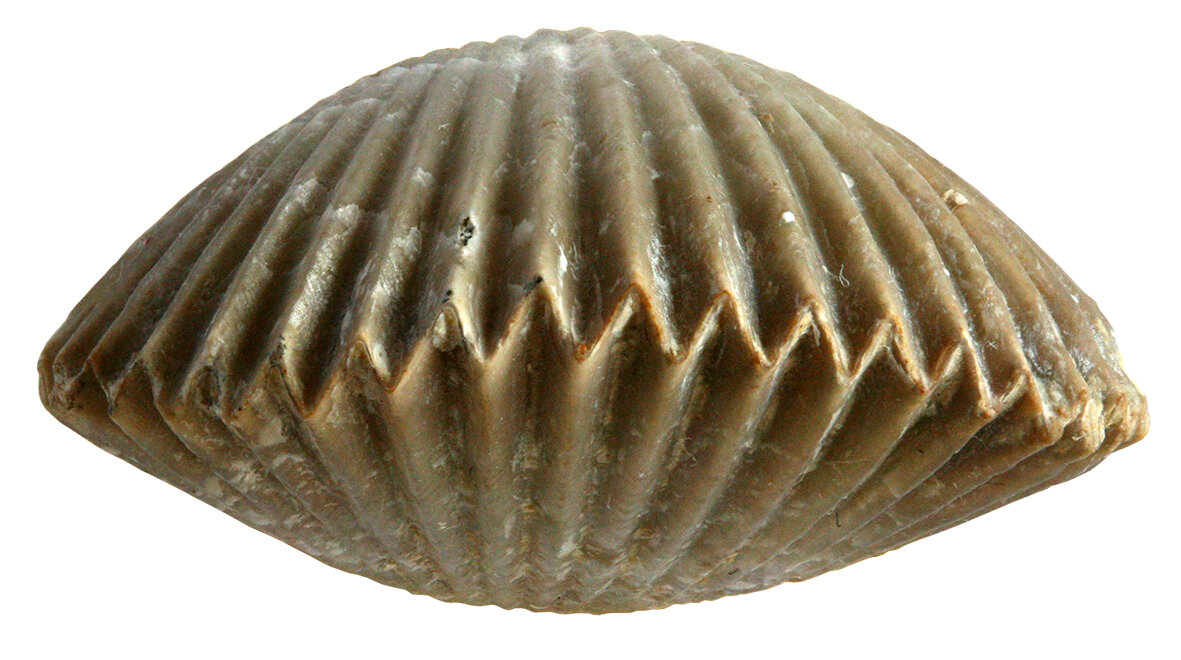
Perfect interlocking of the two valves in the brachiopod fossil Kutchirhynchia obsoleta. Credit: Régis Chirat
Using math and mechanics, a trio of researchers, two from the University of Oxford, the other the University of Lyon, have learned more about how bivalve shells fit together so well. In their paper published in Proceedings of the National Academy of Sciences, Derek Moulton, Alain Goriely and Régis Chirat describe their approach to understanding the interlocking mechanism of bivalve shells.
Many people who have handled a bivalve creature, such as a clam or oyster, have marveled at how seamlessly the top and bottom shells fit together. The researchers with this new effort noted that such close-fitting shells evolved in two phyla from a common ancestor. They also noted that even irregularities, whether natural or from an injury, do not generally prevent shells from neatly closing—and it works equally well in bivalves with either flat or wavy edges. The researchers also noted that the near-perfect alignment of edge features happens despite the two edges forming from two distinct  lobes.
To explain how such a near-perfect alignment arises in the bivalves, the researchers created a mathematical model of the shell growth process. They started by noting that the edges of the bivalve shells grow throughout the creature's life—they also noted that there are differences in modes of secretion and general anatomy between bivalves and brachiopods (the other phyla with matched shell halves). But they also noted that with both groups, the shells are incrementally secreted by a mantle—a thin membrane-like organ. They further noted that the mantle secretes a soft layer that functions as a matrix for the formation of the calcium carbonate shell.
They next took into consideration the geometry of the shell halves and the mechanics involved when they come together, and the constraints involved. They used such factors to develop a model that showed how such evenly matched shells could arise. The reason the edges in some species are wavy is because the mantle grows at a faster pace than the  edge, resulting in buckling. The interlocking pattern that emerges, they found, is constrained by the forces of the shells when closed.
Using math and mechanics to explain how bivalve shells fit together so well
A simulated bivalved shell following the model formulation exhibits perfect interlocking. Credit: Derek E. Moulton

Fun Facts

October 14th is celebrated as World Maths Day. Let us know some interesting and amazing facts about Mathematics.
1. Zero ( 0 ) is the only number which can not be represented by Roman numerals.
2. What comes after a million, billion and trillion? A quadrillion, quintillion, sextillion, septillion, octillion, nonillion, decillion and undecillion
3. Plus (+) and Minus (-) sign symbols were used as early as 1489 A.D
4. 2 and 5 are the only primes that end in 2 or 5
5. An icosagon is a shape with 20 sides
6. Among all shapes with the same perimeter a circle has the largest area.
7. Among all shapes with the same area circle has the shortest perimeter
8. 40 when written "forty" is the only number with letters in alphabetical order, while "one" is the only one with letters in reverse order
9. 'FOUR' is the only number in the English language that is spelt with the same number of letters as the number itself
10. From 0 to 1,000, the letter "A" only appears in 1,000 ("one thousand")

Monday, November 25, 2019

Fun Facts 


1. If you write out pi to two decimal places, backwards it spells "pie".


3.14 = PIE


Brain Teaser 


5625/25=225=2+2+5=9
625/25=25=2+5=7
25/25=1

Brain Teaser

3 Friends went to a shop and purchased 3 toys. Each person paid Rs.10 which is the cost of one toy. So, they paid Rs.30 i.e. total amount. Shop owner gave a discount of Rs.5 on the total purchase of 3 toys for Rs.30. Then, among Rs.5, Each person has taken Rs.1 and remaining Rs.2 given to the beggar beside the shop.
Now, the effective amount paid by each person is Rs.9 and the amount given to beggar is Rs.2. So, total effective amount paid is 9*3 = 27 and the amount given to beggar is Rs.2, thus the total is Rs.29. Where has the other Rs.1 gone from the original Rs.30 ?????
View answer
The logic is payments should be equal to receipts. we cannot add amount paid by persons and amount given to beggar and compare it to Rs.30.
The total amount paid is Rs.27. So, from Rs.27, shop owner received Rs.25 and beggar received Rs. 2. Thus, payments are equal to receipts.
Puzzle Time

A teacher gave 13 marks to one student and 12 marks to another student in one exam.
Can you tell the TIME by using the above sentence ????
View answer

Answer : 1.45

The teacher gave a total of 25 marks to two students. 25 is
a quarter.
So, teacher gave “Quarter to Two”.
Time format to “Quarter to Two” is 1.45.

Monday, October 21, 2019

Mathematics

Algebra - 8th Grade

Top 7 Math Websites


Want more free math resources specific to your grade level? Then check out some new articles we just wrote linked out below! Stay tuned… more to come!
BONUS RESOURCE: Have a student in K – 8th grade? Want them to be prepared for the digital age? Then you may want to check out Codakid, an organization that teaches kids how to code! Computer coding for kids! 🙂
Now let’s get to the countdown!…

1. Art of Problem Solving

Math Levels: pre-Algbera – Algebra (approximately 3rd – 11th grade)
My Favorite Thing: their videos are organized, clear, helpful, and free!
This math website has lots of stuff including math discussion forums, math competition information, and classes students can enroll into… but we especially like their clear videos!

2. Education World

Math Levels: K-12th (but seems heavier on K-8th grade)
My Favorite Thing: free downloadable worksheets
This site links to www.freeprintableonline.com and has downloadable pdfs of its own on critical thinking, math crossword puzzles, and hands-on math activities like these two shown below.

3. Math Pickle

Math Levels: K-12th
My Favorite Thing: videos and activity resources to do with students

4. Paul’s Online Math Notes

Math Levels: 9-12th+ (Algebra through Calculus III)
My Favorite Thing: “cheat sheets” – nice review study guide reference sheets!

Math Levels: K-6th grade
My Favorite Thing: super fun “arcade games” practicing math

Math Levels: 3rd-12th+ (basic math through Calculus III) plus ACT & SAT Prep!
My Favorite Thing: videos galore, easy-to-navigate

7. Patrick JMT

Math Levels: 3rd-12th+ (arithmetic through Calculus)
My Favorite Thing: videos galore, easy-to-navigate
The “JMT” in Patrick JMT stands for “Just Math Tutorials.” Math, math, and more math.

Thank You.

Friday, October 4, 2019

The Basic Steps to Learning How to Use a Computer


Learning to use a computer for the first time can be a daunting process, but it doesn't have to be. Understanding the basics of a computer will help to take the fear out of it. The best way to learn how to operate a computer is simply to get in front of the monitor and use the mouse and keyboard. The more you use the computer, the easier it will become. Before you know it, you will be opening, saving and closing files without thinking about what you are doing.

Step 1

Familiarize yourself with the hardware. Every computer is going to have a display. If it's separate from the computer it is called a monitor; if it is attached it is a screen. All computers have a keyboard for inputting information as well as a mouse or touch pad for navigation. Computers will also have a shell that connects everything together. Most computers today also have an optical drive that can read DVDs or CDs and allows you to install programs onto your computer.

Step 2

Power up the computer. The computer will boot into Microsoft Windows, if that is your operating system, automatically. Use the mouse to move the cursor around on the screen and familiarize yourself with what each of the computer icons do when you do a quick double-click on one of them. Click the "Start" button on the lower left corner of the computer screen

Step 3 

Navigate through the different areas of the computer. Look mainly at "Programs," this is the bulk of where everything you can run on your computer rests. Opening programs and clicking on "Help" from inside the program will give you more information about what it is capable of doing. Open "Internet Explorer" to begin looking around the Internet. This is your gateway to the rest of the world and its information